
A Historical Premise Lost in Formula
As a socio-political action drama, Pallichattambi raises compelling questions about exploitation, land rights, and identity. While the premise is intriguing on the surface, its potential is undermined by a formulaic narrative overloaded with melodrama.
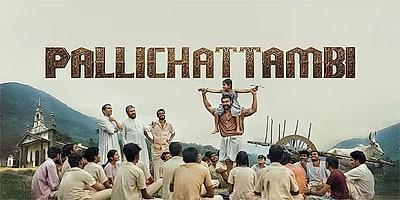
Set in 1957 in the hilly border village of Kaaniyar between Kerala and Karnataka, the film follows Krishnapillai, aka Pothen Christopher, played by Tovino Thomas. Brought from his native Thomapuram by priest Gregory (TG Ravi), Christopher is entrusted with safeguarding the land and rights of the local Christian parish against encroachment during a politically turbulent period. Under the guidance of Fr Pulamplaavil (Vijayaraghavan), he organizes a youth force to resist the Agrarian Relations Bill, tying the narrative to the historical Liberation Struggle (Vimochana Samaram).
The film attempts to explore how land reforms impact the villagers and whether Christopher emerges as their savior. Director Dijo Jose Antony leans heavily into a mass-action framework, complete with exaggerated heroism and clearly defined antagonists. S Suresh Babu's screenplay is riddled with overdramatic moments, portraying Christopher as an almost mythical protector, which dilutes emotional authenticity.
A notable subplot is Christopher's relationship with Rebecca, a drama artist and comrade played by Kayadu Lohar. Her character adds some ideological depth, particularly in highlighting the intended benefits of land reforms. However, the romantic and emotional arcs often feel contrived. The protagonist's backstory and introduction rely on familiar tropes, and the villagers' unwavering dependence on him borders on excessive dramatization.
The introduction of the main antagonist offers a brief spark but lacks lasting impact. The climax, featuring a face-off between hero and anti-hero, ends ambiguously without providing satisfying closure or meaningful setup for a sequel. Despite the film's reliance on action, the fight sequences are poorly executed, with unconvincing choreography and subpar CGI.
The conflict surrounding land acquisition-driven by a former bureaucrat Eapen (Siddique) and local figure Kunjambu Nambiar-initially adds intrigue. However, the narrative soon devolves into a conventional mass masala spectacle, further complicated by the inclusion of a brutal Karnataka police officer, Rairu Ramanna (Shatru), whose presence amplifies the chaos rather than the story.
Though the political dimension briefly gains nuance-especially through Rebecca's perspective on social welfare-the film ultimately simplifies its themes. The writing lacks depth, and the predictable progression weakens its socio-political commentary.
Tovino Thomas delivers a physically convincing performance, embodying the rugged, rebellious persona effectively. His effort is evident, but the inconsistent script leaves little room for a more layered portrayal.
Technically, Jakes Bejoy's background score adds intensity to the action sequences, but it cannot compensate for their lackluster execution. Despite being inspired by a significant historical moment, Pallichattambi ends up as a half-realized narrative, with strong ideas lost in a flawed and overly commercial treatment.